16 Jul
Access to Justice in Kenya has improved tremendously over the last two decades. Launched on a pilot basis in October 2005 by Safaricom and Vodafone, M-Pesa was built to do one thing: let unbanked, pre-pay mobile subscribers move money without a bank account. Nobody involved in its early design was thinking about civil litigation. And yet two decades later, M-Pesa sits quietly at the centre of one of the more genuinely underrated access-to-justice stories in Kenyan legal history.
The court that was built to be affordable if you could reach it
The Small Claims Court Act, 2016 created a specialised court specifically to remove the traditional barriers to justice for low-value disputes: court filing fees, complex legal procedure, and lengthy timelines. The court hears civil claims up to KSh 1,000,000, including unpaid invoices, disputed deposits, minor property damage, and personal injury claims under the threshold, and is statutorily designed to resolve matters within 60 days, presided over by an Adjudicator rather than a Magistrate.
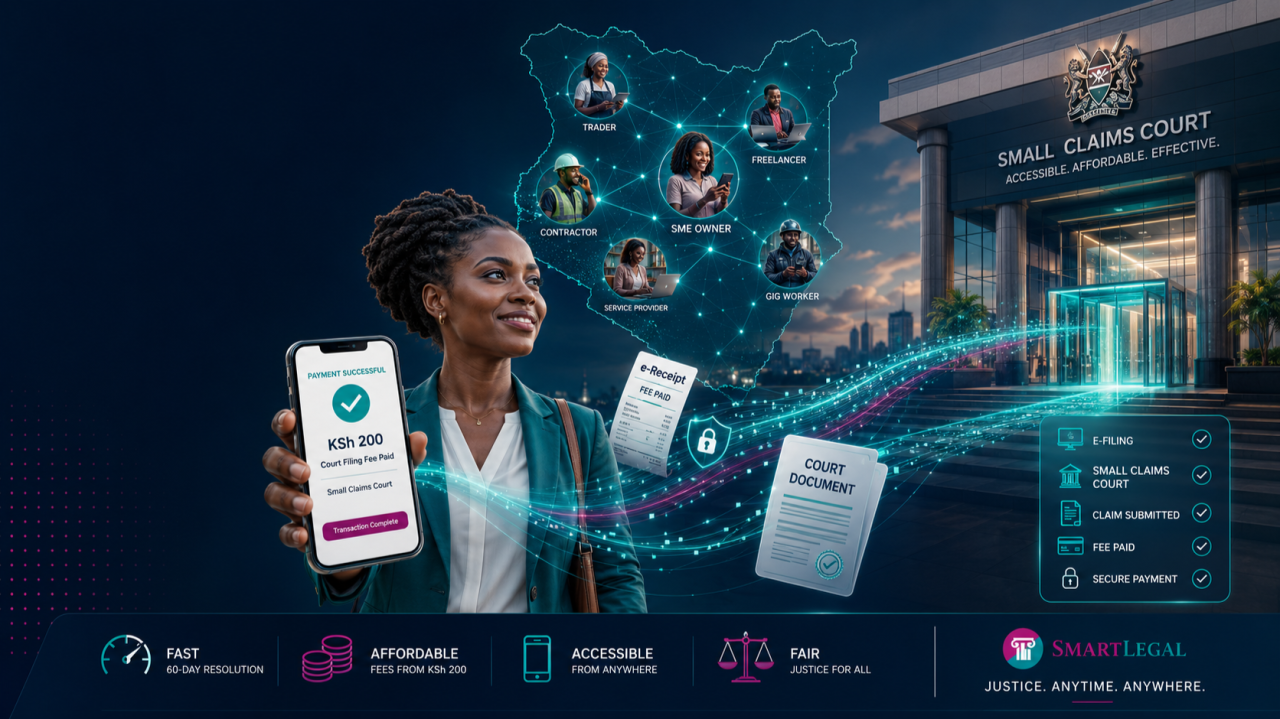
Filing fees were deliberately kept low, starting from as little as KSh 200 depending on claim value, specifically to fulfil the right to access justice under Article 48 of the Constitution of Kenya, 2010. On paper, this was already a strong design. But a low fee that requires a half-day trip to a court registry, cash in hand, during business hours, is still a real barrier for the SME owner or gig worker the court was built to serve.
Where mobile money quietly closes the gap
This is where the e-filing portal and mobile money intersect in a way that’s easy to overlook precisely because it works so smoothly. Once a claim is filed through the Judiciary’s e-filing portal, the system calculates the appropriate fee automatically, and a claimant can pay directly through M-Pesa, Airtel Money, card, or bank transfer, without setting foot in a court building at all.
For the specific population the Small Claims Court was designed to serve SMEs chasing unpaid invoices, freelancers and content creators who’ve delivered work and not been paid, and small traders disputing a damaged shipment – this collapses what used to be a multi-step, multi-hour process into something that can happen from a phone, between client meetings.
A trader in Eldoret no longer needs a free weekday morning and bus fare to Nairobi to start recovering an unpaid invoice. They need a phone and an M-Pesa PIN.
The numbers behind why this matters so much
Mobile money’s reach in Kenya isn’t a footnote; it’s close to universal. By 2012, roughly 17 million M-Pesa accounts had been registered in Kenya alone, a number that has only grown substantially in the years since. That scale matters enormously for a justice system trying to reach citizens outside the major urban centres where most law firms and court registries are physically concentrated.
It’s worth being honest about the limits here too. M-Pesa’s withdrawal fees have drawn legitimate criticism for imposing real costs on Kenya’s poorest users, roughly 10% on small withdrawal amounts, by some estimates. Convenience and affordability aren’t the same thing, and a genuinely accessible justice system needs to keep both in view rather than declaring victory on access while quietly shifting cost onto the people least able to absorb it.
What this means for the firms and clients building on this infrastructure
For Kenyan law firms, particularly those serving SME clients chasing unpaid invoices or commercial disputes under the KSh 1 million threshold, this digital-payments layer of the justice system isn’t a side detail. It’s a genuine competitive advantage for firms that understand how to use it well. A firm that can walk a client through e-filing and mobile payment in a single sitting, rather than sending them off to a court registry queue, is offering a materially better client experience than one still operating on paper-first assumptions.
It’s also a useful reminder of a broader pattern worth sitting with: some of the most meaningful access-to-justice innovation in Kenya hasn’t come from inside the legal profession at all. It came from a telecoms company, solving an entirely different problem, twenty years ago, which the justice system later discovered it could build on. The lesson for firms thinking about their own technology adoption isn’t “wait for legal-specific tools”; it’s to recognise good infrastructure wherever it shows up, and be ready to use it.