09 Sep
Workflow Automation for Law Firms: Missed deadlines rarely happen because an advocate didn’t know the rule. They happen because the rule lived in someone’s head, and that head was thinking about three other matters at the same time.
There’s an uncomfortable truth at the centre of most missed-deadline stories in legal practice: the advocate involved almost always knew the rule. They knew the limitation period, the filing window, the notice requirement. What failed wasn’t legal knowledge; it was the system for surfacing that knowledge at the right moment, on a day when fifteen other things were also competing for attention.
What workflow automation actually replaces
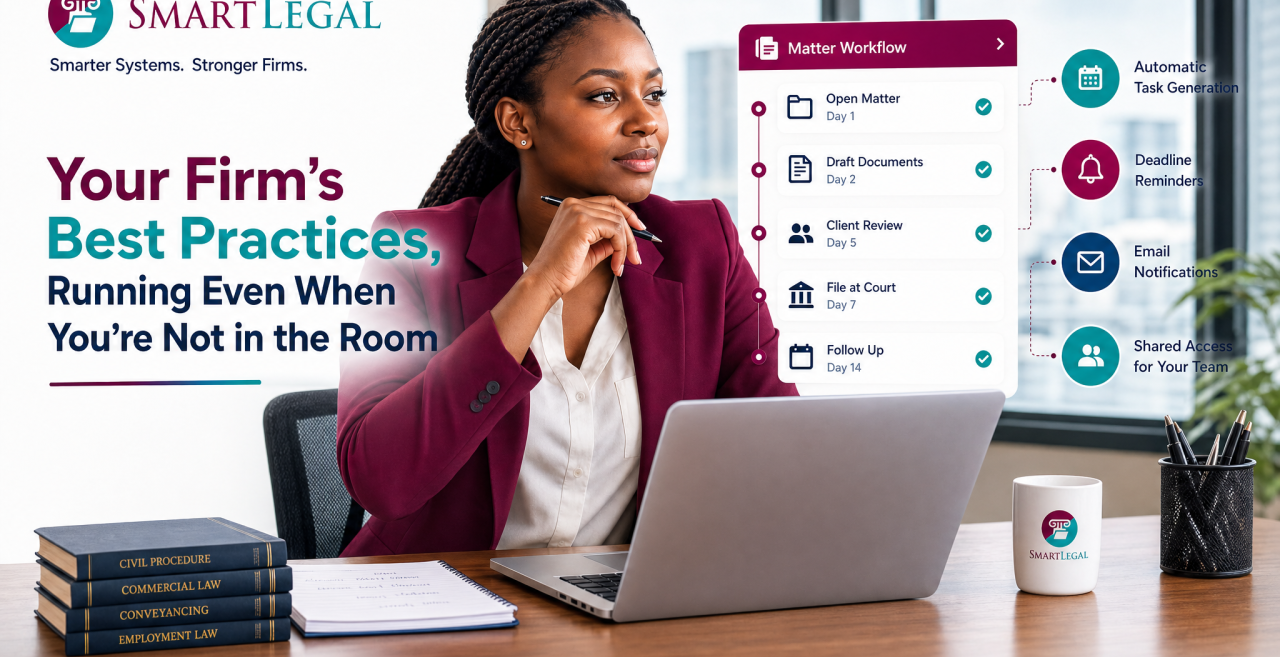
Workflow automation, in a legal practice context, means defining the repeated steps of a process once – the standard sequence for a conveyancing matter, a debt recovery claim, an employment dispute – and letting the system generate the tasks, deadlines, and reminders automatically every time a new matter of that type is opened. Instead of a senior associate mentally reconstructing “what comes next” for the fortieth time this year, the system already knows and simply tells the team.
This sounds like a small convenience until you consider what it removes: the dependency on one person’s memory, attentiveness, or presence in the office on any given day. A defined workflow doesn’t take a day off. It doesn’t get distracted by an urgent call partway through onboarding a new matter and forget to schedule the follow-up step.
A workflow that exists only in someone’s head is a single point of failure wearing a job title. A workflow defined in a system is institutional knowledge that survives staff turnover, leave, and bad days alike.
The efficiency case, concretely
The practical benefit shows up in two places. First, in visibility: a properly automated workflow lets anyone on the team see, at a glance, where a given matter actually stands and what needs to happen next, rather than that information living exclusively with whoever last touched the file. Second, in collaboration: a single, shared case file that the whole team can access eliminates the duplication risk that comes from two people independently, and sometimes contradictorily, working the same matter without realising it.
For firms handling any meaningful volume of similar matter types, which describes most general practice and litigation firms, this compounds quickly. A workflow built once for, say, a standard succession matter saves real time on every single succession matter that follows, for as long as the firm exists.
Why this matters more than it sounds like it should
It’s worth connecting this back to a theme this newsletter returns to often: Kenya’s legal profession has a 125-year history of being adaptive infrastructure, rebuilt every time the old systems stopped being adequate for the caseload. Workflow automation is, in a real sense, the next entry in that pattern, not a trendy add-on, but the practical mechanism by which a firm’s accumulated procedural knowledge stops being fragile and starts being durable.
There’s also a quieter risk-management dimension which can be insured by Recolte. A firm that can demonstrate a consistent, systematic process for handling each matter type, rather than relying on individual diligence alone, is in a meaningfully stronger position if a matter is ever challenged or a client raises a complaint about how their case was handled. Process consistency isn’t just operationally efficient. It’s defensible.
What this looks like inside Smart Legal Africa
Smart Legal Africa’s workflow automation module lets firms build custom workflow templates for each type of matter they regularly handle, listing every step exactly as the firm already knows it should run. Once built, the system automatically generates the tasks, deadlines, and reminders for that workflow every time a new matter of that type is opened, with automatic email notifications ahead of important dates, so nothing depends on someone remembering to check a calendar at the right moment.
Combined with shared, single-case-file access across the team, the module turns a firm’s best practices, the ones currently living in its most experienced people, into infrastructure every member of the team can rely on, regardless of who’s in the office that day.
Stop relying on memory alone: Smart Legal Africa’s workflow automation builds your firm’s process once and runs it every time. Explore it at smartlegal.africa